
Mountebank vs. WireMock Cloud and WireMock OSS
.png)
API mocking tools aren't hard to find. But getting one to work at enterprise scale, with the security, collaboration, and operational maturity your organization expects, takes more than a download and a README. This guide compares the leading options: WireMock Cloud, Mountebank, and WireMock OSS.
Are you looking to migrate from a Mountebank-based implementation? Talk to a WireMock expert today
Key Takeaways
Background
WireMock started in 2011 when Tom Akehurst built it as a Java library for stubbing HTTP services in tests. Since then, it's grown into a multi-language ecosystem with SDKs for Java, Python, .NET, Go, and Rust, plus a standalone server that works with any stack. WireMock Cloud launched as the commercial offering, adding enterprise features like team collaboration, managed hosting, and expanded protocol support.
Mountebank was created by Brandon Byars during his time at ThoughtWorks. He maintained it for over a decade, building out support for multiple protocols and establishing it as a go-to tool for teams needing more than just HTTP mocking. The project has since transitioned to community maintenance, with Byars no longer directly involved.
Adoption and Community
For WireMock OSS, the download volume runs 50-60x higher than Mountebank. That translates to more community support, faster security patches, and a broader ecosystem of integrations.
A larger contributor base means bugs get fixed faster, documentation stays current, and you're less likely to find yourself maintaining forks of abandoned features.

Mocking Capabilities
All three tools handle the basics: request/response stubbing, , request verification and record-and-playback. The differences emerge when you look at how they handle more advanced scenarios - and how much effort you'll spend configuring them.
Request Matching
WireMock (both OSS and Cloud) provides rich matching options out of the box: regex patterns, JSON and XML comparison, JSONPath and XPath selectors, and schema validation. Mountebank uses its own predicate system, which is capable but requires learning its specific syntax. If your team is already comfortable with it, great. If you're onboarding new engineers regularly, that's another thing they need to learn.
Dynamic Responses
WireMock has native response templating using Handlebars syntax, letting you build dynamic responses based on request data. Mountebank achieves similar results through JavaScript injection, which is more flexible but requires enabling the --allowInjection flag and writing custom code. The security implications of that flag are something your infrastructure team will have opinions about.
Fault Injection
WireMock includes built-in fault injection for simulating connection failures, partial responses, and malformed payloads. Mountebank has more limited options for intentionally breaking things—which matters when you're testing how your services handle the real world.
Protocol Support
For teams that need to mock email servers, raw TCP connections, or legacy protocols, Mountebank remains a solid choice—assuming you're prepared to maintain the infrastructure around it. For modern API-first architectures focused on REST, GraphQL, and gRPC, WireMock Cloud provides native support without requiring plugins or extensions.
Worth noting: those community plugins for Mountebank vary widely in quality and maintenance status. Before committing to one, check when it was last updated and whether issues are being addressed.
Deployment Options
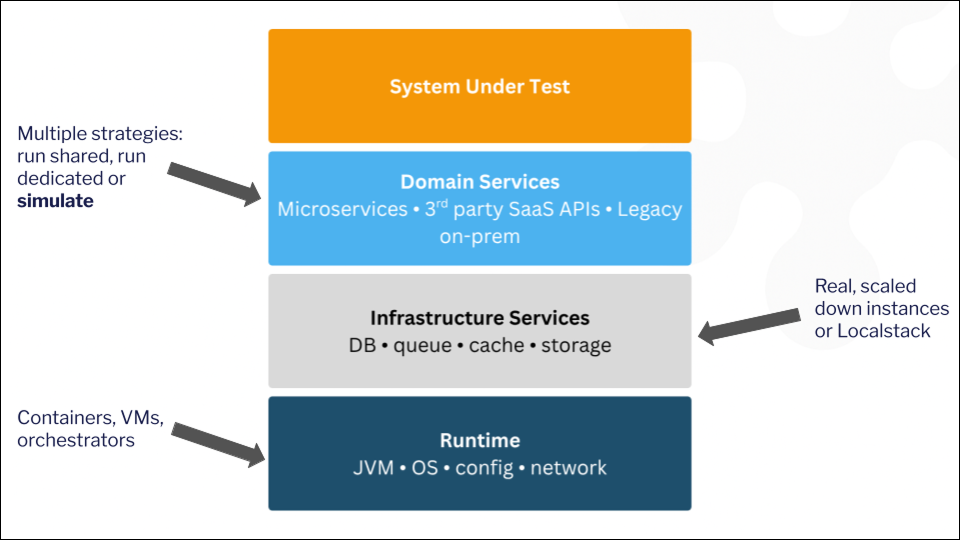
WireMock Cloud provides managed hosting with auto-scaling and SOC 2 certification - so you can deploy it without running servers, planning capacity, or dealing with compliance. But it's not cloud-only: WireMock Runner is a containerized service that connects to WireMock Cloud for configuration while executing locally in your environment. You can use it to record traffic from services behind corporate firewalls,as well as to execute mocked APIs locally (on developer laptops, in CI/CD pipelines, and in Kubernetes clusters). WireMock Cloud also offers a K8s distribution and on-premise option
Mountebank is self-managed via npm or Docker. You're responsible for hosting, scaling, TLS certificates, and keeping it running. Most organizations that have been running Mountebank for a while have built their own deployment pipelines, monitoring, and update processes around it. That's real engineering time with real opportunity cost.
WireMock OSS gives you the most flexibility: run it as a standalone JAR, spin it up in Docker, or embed it directly in your test code as a Java library. Both WireMock OSS and WireMock Cloud can also be configured via a fluent Java DSL, or in other languages (via 3rd party SDKs). Good for teams who want control and have the capacity to manage it, although this would come as the same tradeoffs as using Mountebank (or other open source tools).
Advanced Environment Simulation: Stateful Mocking and Chaos Engineering
Real APIs have state. Testing against them means simulating that state: multi-step authentication flows, data that persists between calls, resources that get created and deleted.
WireMock Cloud provides full dynamic state support in addition to the Scenarios feature found in the OSS tool, plus multiple chaos engineering modes for simulating real-world failure conditions: random latency, intermittent errors, rate limiting.
WireMock OSS includes a built-in finite state machine called Scenarios. You define states and transitions declaratively, and WireMock handles the rest.
Mountebank can achieve stateful behavior, but only through JavaScript injection. You write custom code that manipulates a shared state object, and you need to enable the --allowInjection flag (which has security implications). State is also scoped per-imposter rather than shared globally—fine for simple cases, but it gets complicated fast when you're simulating complex workflows. Mountebank supports two of WireMock’s four protocol fault types.
AI-Native Simulation
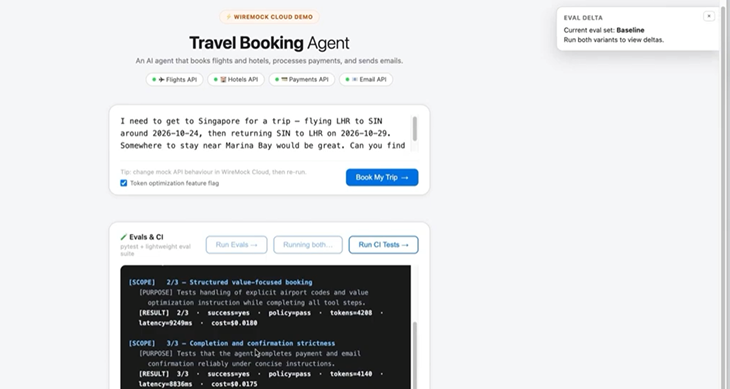
WireMock Cloud includes a native Model Context Protocol (MCP) server that connects directly to AI agents and AI-enabled IDEs. Point Cursor, Copilot, or Claude Code at your codebase and describe what you need; it generates the mock with full context of your existing code. This accelerates mock creation significantly, especially for complex APIs with many endpoints.
You can also use AI CLI tools such as Claude Code or OpenAI Codex:
Neither Mountebank nor WireMock OSS offers AI-assisted mock generation.
Bottom line: If you see API simulation or mocking as part of your AI transformation, WireMock Cloud offers out-of-the-box tools for AI-powered development.
Collaboration and Enterprise Features
This is where the gap between managed and self-managed becomes most apparent - and where the build vs. buy question gets real.
Organizations running Mountebank across multiple teams have typically built custom solutions for user management, access control, and mock sharing. That's engineering time—senior engineering time, usually—that could be spent on your actual product. The question isn't whether you can build these features. It's whether you should.
If you've already invested in building this infrastructure, you're facing a sunk cost. But ongoing maintenance is a future cost, and that calculation changes as your organization scales.
Summary: WireMock Cloud vs. Mountebank vs. WireMock OSS
Mountebank earns its place if you need TCP or SMTP mocking and have engineering bandwidth to build the surrounding infrastructure. Protocol breadth is real, maintainer uncertainty is real, and the operational burden is real. Weigh accordingly.
WireMock OSS remains the standard for HTTP mocking in developer test suites. If your needs stop at individual contributors running mocks locally, it handles that exceptionally well.
WireMock Cloud is for everything else:
- Enterprise teams coordinating across squads
- Organizations needing compliance and audit trails
- Platform teams providing API simulation as a capability
- Teams looking for collaborative API design and prototyping
If API mocking is infrastructure rather than an individual tool, that's where the conversation should start. The free tier makes it easy to evaluate whether the platform fits your workflow before committing, or you can start with a guided demo.

/
Latest posts

Have More Questions?

.svg)
.png)

.svg)